Page 1 of 4

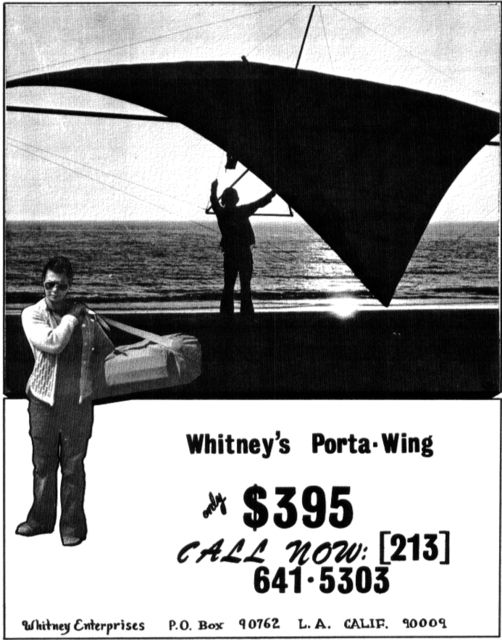
Vintage "WHITNEY" Hang Gliding Sales Brochure & 4 Photos:

PostPosted: Sun Feb 14, 2016 10:01 pm
by dhmartens
http://www.ebay.com/itm/like/3515341856 ... 1534185694

A truly portable hang glider. 30 years later the patent has wore off.

4 photos ebay brochure.
Image

Image

Re: Vintage "WHITNEY" Hang Gliding Sales Brochure & 4 Photos

PostPosted: Sun Feb 14, 2016 11:28 pm
by Frank Colver
I posted sometime back that this was the only hang glider that I was scared to be directly underneath on a hillside (others agreed). I was not impressed with the flight performance of the Portawing.

FC

Re: Vintage "WHITNEY" Hang Gliding Sales Brochure & 4 Photos

PostPosted: Mon Feb 15, 2016 3:56 am
by ARP
With the cabled leading edge I suspect low angles of attack may have caused it to dip resulting in sail deflation. As a precaution a cable could have been added from the king post as was done later on the trailing edge for all flexwings.

Re: Vintage "WHITNEY" Hang Gliding Sales Brochure & 4 Photos

PostPosted: Mon Feb 15, 2016 10:54 am
by JoeF
There was ordinary copyright over inked line art and text; there was no functional or process patent or design patent. Eddie Paul still retains copyright over the images and text that he published, like the image shown in the first post; Eddie Paul is subject of a topic thread in our forum; he is considering presently moving his business from El Segundo, Calif. to Texas.
The wing is discussed elsewhere in our forum and elsewhere. Mods have been suggested toward keeping LE sail region formed positively during negative gust events and during low AoA dynamics. Segmenting tubes for short pack has been centuries old. The airfoil was not patentable as it was in public domain. Ancient kiting has had cable leading edge in public domain. Solve the challenges of deformation of the airfoil in LE region under low AoA and/or gust events. Check all that has been published on the hang glider.

Re: Vintage "WHITNEY" Hang Gliding Sales Brochure & 4 Photos

PostPosted: Mon Feb 15, 2016 12:34 pm
by dhmartens
http://www.nastyz28.com/forum/archive/i ... 21954.html

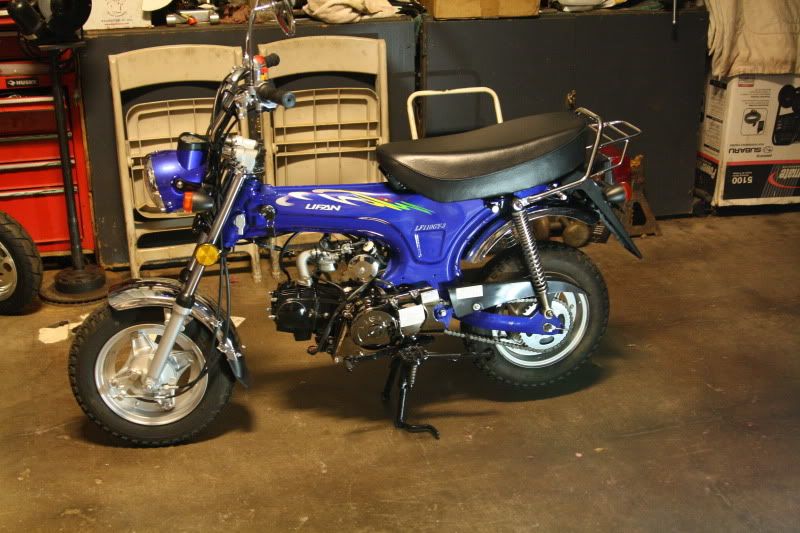
The 1970 Honda ct-70 motorbike:
Oh, about parts.......easy to find. There's tons of stuff on ebay, and lots of specialty houses like Beatrice Cycle that have everything you need. There's also lots of Chinese stuff available, the engine parts are decent because they are a 100% copy of the original Honda design because the original patent ran out, but the non-engine parts are pretty crappy. Typical Chinese stuff.....


Skyteam, trailbuddy,Piranha,etc all Chinese companies that cloned the ct-70 after the patent ran out. They improved it with 125cc motor over stock 70cc motor otherwise completely compatible parts. The Whitney glider could be improved too.

Original
Image
Clone
Image

Re: Vintage "WHITNEY" Hang Gliding Sales Brochure & 4 Photos

PostPosted: Mon Feb 15, 2016 2:33 pm
by Rick Masters
Image
The Whitney glider could be improved too.

Image
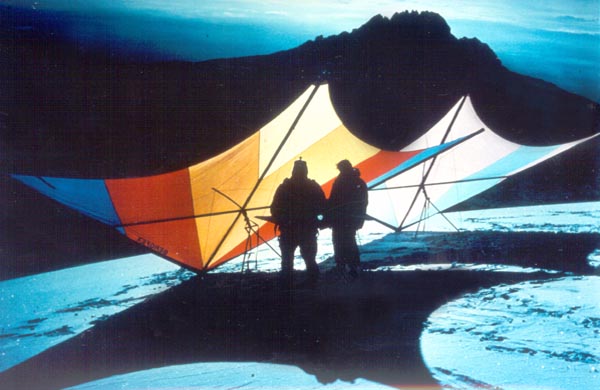
1975: Mt. Misti, Peru -- Hang gliding legend Thomas Finsterwalder (center)
Image
1976: Mt. Kilomanjaro, Tanzania
Image
1973-1977
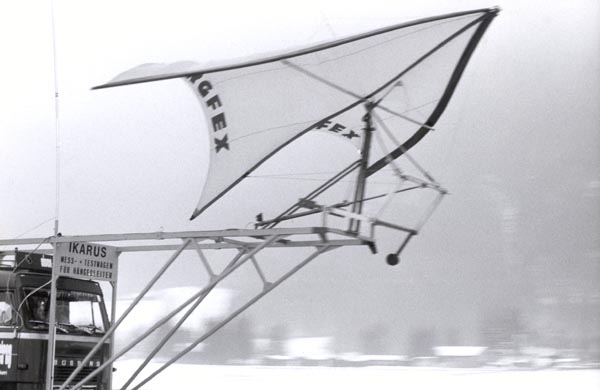
Thomas Finsterwalder develops a glider of his own design.
With specially developed high-strength super light-weight and large diameter tubing, the "Bergfex" (mountain freak) weighed a mere 11 kg and could be dismantled in 8 minutes down to a length of 1,80 m without the use of tools, by means of snap fasteners.
Mountaineering pilots were excited to try them - soon, no peak was safe from them anymore.
More than 300 Bergfexes flew accident-free.
https://finsterwalder-charly.de/finster/html_eng/main/ueber_uns.php

Image
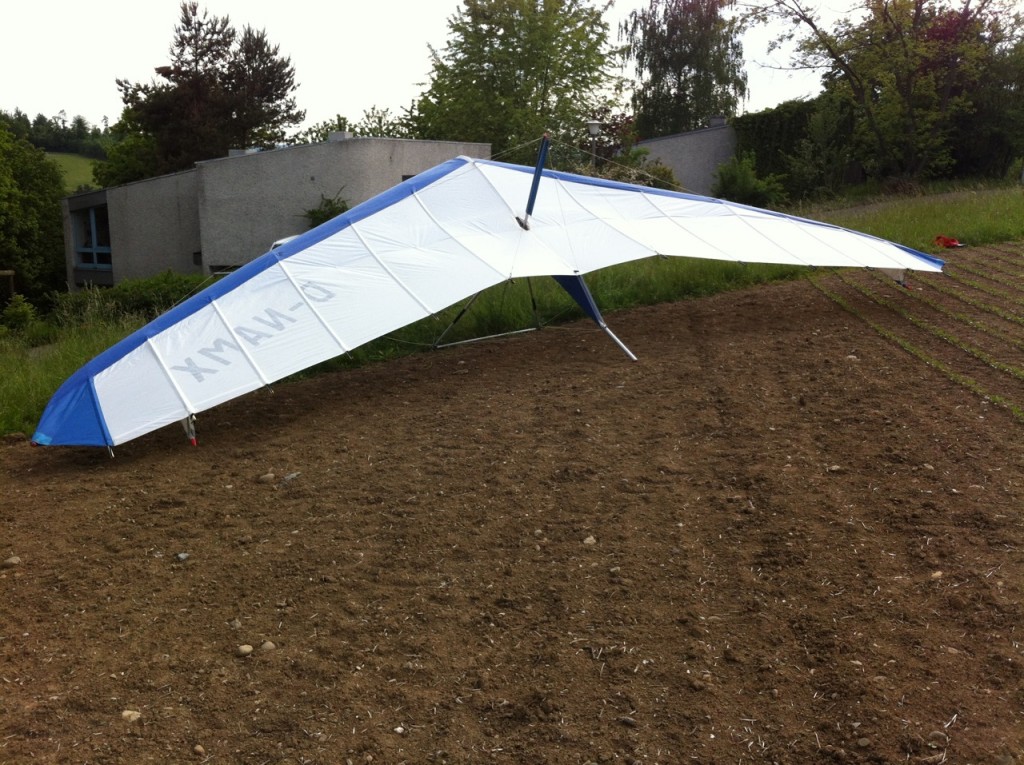
I flew with a couple of Swiss pilots on new Finsterwalder Windfexes in the Owens in 1981 and they had no problem keeping up with me in my 10m Seagull copy.
Image
Image
Image
Image
Improve on this. Less than 2m packed. Compared to this incredible work of art, the most modern paraglider is a deadly piece of garbage in any performance comparison.

Re: Vintage "WHITNEY" Hang Gliding Sales Brochure & 4 Photos

PostPosted: Fri Feb 19, 2016 10:52 pm
by Bob Kuczewski
Thanks for contributing all these ideas. This is probably the most important issue for the future of hang gliding.

Did Whitney's Porta-Wing have battens? I'm thinking they might have helped considerably in the negative angle of attack situation. Also, an inflatable leading edge for aerodynamics (not structure) might be another modern addition.

Does anyone know of a Finsterwalder in Southern California? I'd like to see one at the Otto Meet in May. :idea: :thumbup:

Great topic!!!

P.S. One of the reasons that I bought my Falcon 3 was the short pack option. It can be done, but it takes a few hours and I get the feeling that doing it too often could end up damaging some parts (stripping screw threads, etc). I wonder if Wills Wing would be interested in overcoming those problems to make short packing (and unpacking) more convenient?

Re: Vintage "WHITNEY" Hang Gliding Sales Brochure & 4 Photos

PostPosted: Sat Feb 20, 2016 7:48 am
by ARP
Bob,

As far as I know the Porta-Wing had no sail battens. The cabled leading edge could be built up using water pipe insulation that might help reduce the oscillation/vibration. This would still allow the short pack capability. With an anti-dip cable on the L/E and reflex lines, wide keel pocket, battens and a more rounded L/E the Porta -Wing might have a new lease of life.

Tony

Re: Vintage "WHITNEY" Hang Gliding Sales Brochure & 4 Photos

PostPosted: Sat Feb 20, 2016 10:15 am
by ARP
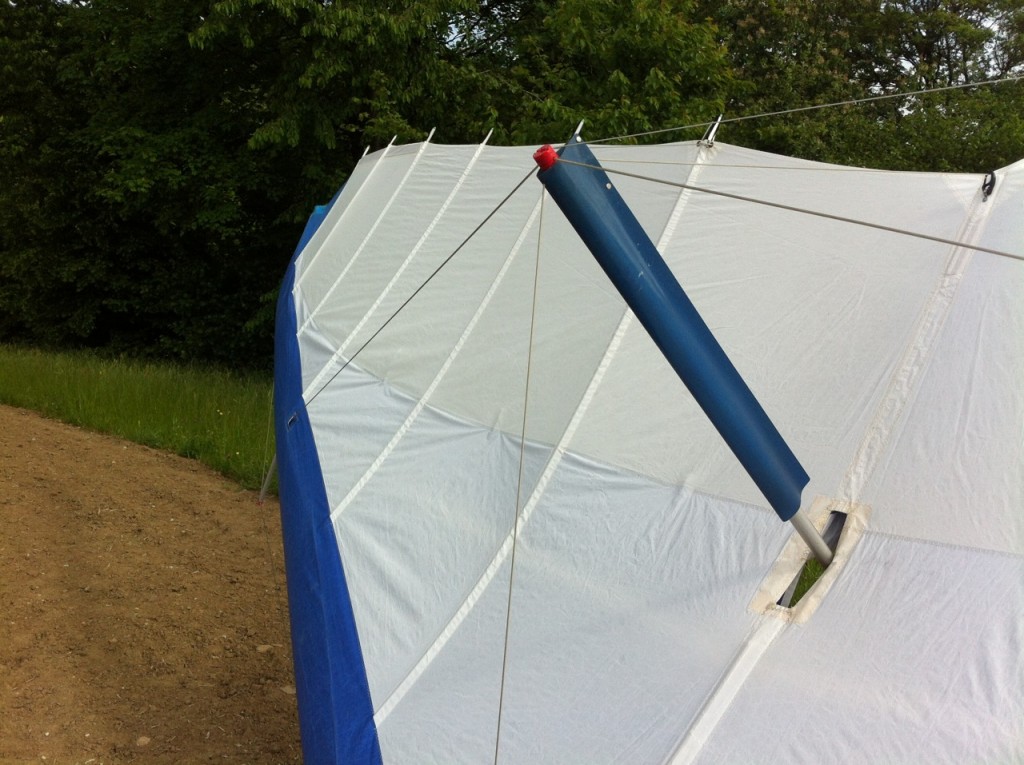
The attached picture shows the L/E support wire from the king post. As with reflex lines it is slack in normal flight.

Just noticed the claim on the leaflet is :- "Cable leading edge for better dive recovery". I 'd say the reverse.

Re: Vintage "WHITNEY" Hang Gliding Sales Brochure & 4 Photos

PostPosted: Sat Feb 20, 2016 10:25 am
by JoeF
Clip from ARP wing above.
LE support line slack during normal flight:
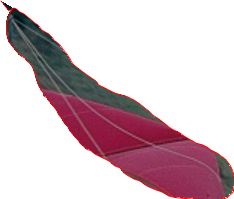
LEsupportLineARP.JPG
LEsupportLineARP.JPG (13.05 KiB) Viewed 13599 times


Cable LE in itself hides the elephant: airfoil stability at low AoA.
(Tautness of cable is a parameter to be faced; vibration or oscillation of the cable is to be reckoned. Even short 6 inch battens set on the cable with a set AoA would go a long ways past a sharp cable that vibrates causing immediate sail material to form different airfoils.)
The cable could be replaced with a fully rigid rod or tube and airfoil stability at low AoA would still be a challenge.
Needed: Stabilize the airfoil.
Consider: Damp the natural frequency of the cable by strategic placement of damping holds.
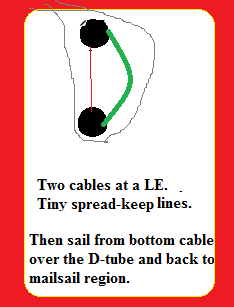
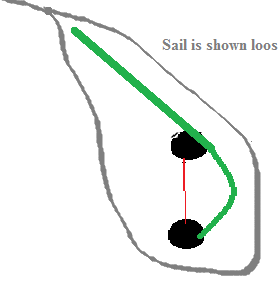
Consider where a cable LE: Two separated cables; then use the separation as a base of hold of a D tube of Mylar sheet; the sheet could be coilable; sail cold upwrap from bottom cable and go up around the D form.

TorqueBattenOnCLE.png
TorqueBattenOnCLE.png (1.78 KiB) Viewed 13598 times

TwoCableLEwDtubeCoilable.png
TwoCableLEwDtubeCoilable.png (5.5 KiB) Viewed 13598 times

TwoCableLEwDtubeExtendedFormingMoreCamber.png
Sail is shown loose.
TwoCableLEwDtubeExtendedFormingMoreCamber.png (7.14 KiB) Viewed 13598 times

Strategic placement of tiny stay-keep lines between the two cables might damp some natural vibrations of the two cables; consider also a fabric web keeping the two cables maximum spread; that fabric web might have a run of a certain foam that would damp some vibrations. Note the option to extend the Mylar sheet up above and back of the upper second cable.