...the work that Bob Wills senior did on hang gliding safety decades ago.
R.V. Wills began compiling fatality data immediately following the first deaths in the sport of hang gliding. At first, he included foreign fatalities. But by the late/middle 1970s, he came under pressure by the organization to limit the numbers to the USA. Other countries followed his lead and limited their numbers to their specific countries. Then the USHGA began listing only their members who died within the USA. The rationale was to illustrate the effectiveness of their training and rating program. Fair enough, but we lost the Big Picture. Also, at the end of the 1970s they made the sensible decision to kick out the power people (who were dying in droves) and no longer count them.
Doug Hildreth assumed the Safety chair and also did a great job through the 1980s. But pilots from many countries who died elsewhere were often never included in a list. This skewed the numbers lower and made hang gliding look better than it was. However, safety in hang gliding did improve because pilot error, which can be reduced through training, was the major factor once the divergence problem was solved. In 1986, about the time I retired from the sport, hang gliding in the USA reflected lower fatality numbers (5) than SSA sailplanes. I was pretty pleased about that and didn't find out that 18 HG pilots died in the USA in 1987 until many years later.
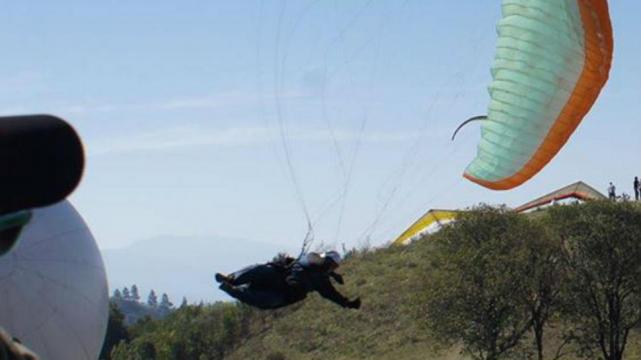
As late as 2002, when I filmed the US PG Nats in Owens Valley, I was unaware of the safety disparity between HG and PG, mainly because the numbers available to the US public were USHGPA numbers and the USHGPA reported ZERO PG fatalities in the USA in 2001. So imagine my surprise, arriving at that meet as Lone Pine Search and Rescue found Bruce Wallace dead on Mt. Langley. Up to that moment, I had thought paragliding was pretty safe. Then I filmed Jody Lucas encounter a dust devil at takeoff, enter a spiral dive in a twist and crash brutally on Gunter (to die near Christmas, never regaining consciousness).
But even then, I just guessed the soaring parachutists had had a bit of bad luck. It was the Owens Valley after all, the most dangerous place for such sports. So I put it out of my mind until 2008, when the USHGPA reported only 2 paragliding fatalities. Then, out of curiosity, I went to Paragliding Forum and asked them what had happened to Jody. They said it was his fault when I knew it wasn't.
Things went downhill from there.
With a little investigating, I discovered that this fragmented system of reporting accidents and incidents makes us all mushrooms, kept in the dark to be spoon-fed bulls***. Honesty will not be tolerated.
I then posted this to ParaglidingForum:
The risk inherent in paragliding is often referred to by paraglider pilots as a "risk vs. reward" judgement.
That is, they will risk their lives, their future and the future of those who may depend upon them by choosing a deficient wing that can suddenly fail in turbulence - if the pleasure they receive leading up to that event is prejudged as substantial.
Incredibly, this choice is made over robust footlaunch wings with airframes that exist, used, within the same price range as new paragliders.
The excuse given in accepting this additional risk is that hang gliders "are not as convenient."
Hang glider pilots also share a risk vs. reward judgement but their wings do not fail in the type of turbulence that fails paragliders.
The risk that hang glider pilots face, flying in the same air and at approximately the same speeds as paraglider pilots, is almost inconsequential.
This is never acknowledged by paraglider pilots.
In their risk comparisons with hang gliders, paraglider pilots without exception will state that, because hang gliders can also fail in turbulence, it follows that the two types of aircraft are equivalent in risk.
This is not true.
It is, in fact, a lie.
Paragliding itself possesses, by far, the greatest inherent risk in popular aviation sports.
This is due to the Paragliding Dead Man's Curve - the PDMC - that illustrates why a paraglider must travel through a zone of no-recourse twice on every flight.
Unlike the helicopter, which has a genuine option to always avoid its own Dead Man's Curve, the paraglider is completely unable to avoid the PDMC.
It must fly through the PDMC at least twice - on takeoff and landing - and the paraglider often spends a great deal of time within the PDMC while ridge soaring or seeking lift.
If the airfoil fails within the the PDMC - that is, if a collapse cannot be recovered - the pilot will be killed or severley injured because within the PDMC the deployment of the reserve parachute is not an option.
The majority of PDMC-related injuries, which is inarguable, are spine and leg injuries which can doom survivors to parapeligic futures.
These types of injuries are not common in hang gliding accidents where the tensioned sail and airframe often absorb much of the impact energy.
Paraglider accidents are, in fact, a massive step up in severity.
This brings us to the fundamental difference between paragliders and all other types of aircraft - including helicopters.
Paragliders present an added layer of risk to the pilot.
This risk is directly related to the PDMC.
It is the added risk accumulated from flying within the PDMC.
This risk is additional to the risk inherent in all other types of sport aviation.
It is also additional to to the risk inherent in flying paragliders above 366 feet - which represents the lower practical limit (4 seconds) of a successful reserve deployment.
Therefore flying paragliders involves two layers of risk - the inherent risk of sport aviation plus the added risk from flying within the PDMC - compared to all other types of aviation, which involve only one.
How large is this risk?
Clearly flight within the PDMC, even for a short period, is much more dangerous than flight above it.
Therefore it is at least twice as dangerous and could easily be assumed to be 100 times or even 1000 times more dangerous.
What is the actual significance of such risk when paragliders are commonly seen to experience safe flights?
The answer is qualifiable - which adds an element of confusion to the issue.
Paraglider pilots will point out that the vast majority of paraglider flights are done safely.
They use these statistics to demonstrate that paragliding is a relatively safe sport.
They will claim that only one accident occurs for every 1000 hours of flying.
This is true.
But what does this really mean?
Paraglider pilots, almost without exception, learn to fly in smooth, laminar, turbulence-free air.
This type of air is commonly found coming in from the ocean or lakes or smooth terrain, often in the morning or later in the evening.
The numbers used to represent paragliding as a relatively safe sport are taken from these areas - where the majority of paragliding occurs.
But the PDMC deals only with an instance of 4 seconds following collapse: the remaining 4 seconds of rapid descent (instigated by turbulence) where a reserve parachute deployment is not possible.
These 4 seconds do not compare well to the three million, six hundred thousand incident-free seconds that make up the claimed 1000 hours in laminar air.
These 4 seconds are significantly weighted in any discussion of paraglider safety.
In fact, the 4 seconds are so significant and the 3,600,000 seconds are so insignificant that the 1000 hour claim is meaningless.
Why?
Because the pilot's life can be lost or forever changed in those 4 seconds.
Those 4 seconds carry real weight.
They mean something.
You cannot compare 4 seconds spent floating peacefully around in the sky with the 4 second emergency that can end or forever change a pilot's life.
Therefore the comparison is invalid.
Risk involves the factor of accumulative time.
Risk assessment assumes that over a period of time and under unchanging conditions, a singularity will occur between Point A and Point B.
This type of analysis - static analysis - is accepted in general aviation, rail and ship travel, and automotive accidents.
Actuary tables are built on static analysis.
But in paragliding, static analysis is meaningless because the novice pilot will frequently progress in skill, experience, equipment choice and site choice to arrive at the new risk realm of inland thermal sites and their dramatically increased risk.
The paraglider pilot will now begin to launch from inland mountains and fly in turbulent conditions.
Sooner or later, turbulence will induce a partial or full collapse of the wing at altitude.
Usually the pilot will recover from the collapse and throughout the remainder of his or her flying career will attribute his recovery to skill and training.
Luck will not be a factor in the explanation.
(This is denial.)
But then, sooner or later, turbulence will induce a partial or full collapse near the PDMC.
This will frighten the pilot, but again, the pilot will recover from the collapse and throughout the remainder of his flying career will attribute his recovery to skill and training.
Here, luck may be acknowledged as a minor factor.
The pilot's odds of encountering turbulence at takeoff, while ridge soaring within the PDMC or descending toward landing increase with the pilot's airtime.
Paraglider pilots encountering a collapse during takeoff, low soaring or landing within the PDMC will not have time to deploy a reserve parachute and therefore must attempt to recover from the collapse before impact.
This often fails, resulting in serious injury or death.
This is often observed and can be studied on YouTube.
To compound this problem, paraglider pilots frequently do not know how close they are to the PDMC because the specifics of the PDMC are often ridiculed by their peers, so they will continue to attempt to recover from a collapse or nose-down spiral dive until they enter the PDMC, eliminating the option of a reserve deployment that may have saved them.
To bluntly recap in an unavoidable way that paraglider pilots in severe denial appear to find offensive, I will state that
1) Paragliders are not true aircraft because they can lose thier ability to fly during flight in conditions that all other forms of aircraft can tolerate. They are therefore stunt parachutes and should be acknowledged as such - particularly to avoid liability issues.
2) Paragliders are not equivalent to any other aircraft, including parachutes, hang gliders or helicopters.
2) Paragliders are the most dangerous of all aircraft when flown in turbulence.
3) Paraglider pilots accumulate risk at a rate of 2 to 1000 times more quickly than pilots of other aircraft flying at approximately the same speeds in the same conditions. This accumulative risk is qualitative and is a function of the average level of turbulent air the paraglider pilot has flown in.
see the reactions at
http://www.paraglidingforum.com/viewtopic.php?t=26621 Home
Home
 by Rick Masters » Wed Aug 20, 2014 8:42 am