Personal Journals about Hang Gliding

Launching methods

Postby JoeF » Mon May 13, 2013 8:56 am

Launching an inhabited hang glider into a hang gliding flight can be done in many ways. (Ending a hang glider flight could be another blog; yet every launch method has at any time of operation a potential of needing a means to safely end the launching operation. Perhaps one might explore the meaning of launching; perhaps launching a hang glider does not end until one obtains flight that seems free of high influence from the launching operations.) Blog-starter opinion: One ought to be well versed in landing a hang glider flight, if one launches a hang glider flight! For ending or landing a hang glider flight, I direct readers to explore landing methods and also the Safe-Splat topic. Launched hang gliders seem always to end in some sort of landing or termination; assure that the characteristics of the end of every flight leaves one able one day to launch again! :idea: :!:
Blog purpose: to gather the various ways that an inhabited hang glider might be launched into a gliding/soaring session. A comprehensive compendium is intended to be eventually displayed. Speculative methods are invited.

Blog rules: Anyone is invited to post notes about some launching method. Especially invited are any safety-critical notes involved in the method in focus. References and links are encouraged. It will be helpful in a post to make it clear what method is in focus for the particular post.

Blog disclaimer: No method is deemed "safe" in and of itself; pilot-in-command is ever to be a now-vigilant safety officer. Posted notes are not necessarily recommendations. Warranties are not given over a method just because some description is given. Each user of a method is to take 100% responsibility for the safety of the method and any parts used therein. If humans beyond the pilot are involved in a method, then it is suggested that teamwork be highly refined. The engineering involved in any method is invited to be of top quality. Most methods are "unfinished" in the sense that there is room for improvement in all aspects of the method, including the user's understanding of the physics, wear of materials, influences of distraction, conditions of the environment, and fitness of the pilots and participants. Awareness of what can go wrong in any method and the means to avoid such is the responsibility of the pilot and participants of an operation. The US Hawks is not responsible for errors or opinions that may be stated in the blog. There will be some poor engineering statements and even potentially bad engineering statements made while exploring launching methods; readers and users are warned to be on guard about such possibilities and thus provide themselves with quality engineering review before risking the use of any certain launch method. Even upon deep care, launching into flight has its risks of injury, even that of deep disability, or death. Mechanical mishaps, breakage, stumbles, surprising agents, vagaries of the wind, distractions, and more may arrive to disturb a launch method; the method users are to take full responsibility for managing the risks of launching and flying. Launching a hang glider into flight may involve people, animals, and property that are not part of the launching operation; users of any method of launching are encouraged to be fully aware of third parties, properties, animals, and plants that may become involved in a launching operation. Launching of a hang glider may be an attraction that draws children, adults, or animals to the point of launching; the users of a launching method are urged to be fully aware of the attraction space and take responsibility for such attraction; there are means for fulfilling such responsibility and notes towards such means are invited into this blog.

Methods' aspects: Methods have aspects. Posters are encouraged to find and describe the various aspects of methods. One aspect would be the purpose of a method; purposes vary. Environmental constraints? Materials? Costs? Preparation time? Place? Time? Wind? Forces? Complexity quotient? Team size needed? Team training and readiness for THIS LAUNCH. Failure modes of a method? Rewards of a method? Wind? Calm? Gustiness? Aborting the method at any point in the operation with what consequences and subsequent actions? A method may be compared with some other method; polite and careful comparisons are invited; but comparing can be a daunting matter, but interesting. How repeatable is the method? And many more aspects.
Join a National Hang Gliding Organization: US Hawks at ushawks.org

View pilots' hang gliding rating at: US Hang Gliding Rating System
JoeF
User avatar
Contributor
Contributor
 
Posts: 4866
Joined: Sat Aug 14, 2010 3:41 pm

Towed by humans to launch HG

Postby JoeF » Mon May 13, 2013 11:46 am

There are many different ways that humans may tow a hang glider for launching the hang glider into a flight session.
To start, I share Bob Grants video that he just released. The method shows the use of a single long towing kiting line. The details of the bridle to the pilot/wing are not said herein yet; perhaps someone will provide the bridling details. Several launching team members are shown running the long line in order to kite the pilot-wing complex. The line is apparently not a bungee, nor a line with a bungee segment in the line; such alternatives form other methods.

"MAN TOW" Hang Gliding WW Demo Days 2013 Wallaby Ranch Florida


Release mechanisms and bridling parts and design are core matters in kiting a kite hang glider.

Many different scenarios may occur. Stalling at low altitude rarely turns out nice. Lockout may occur to bring terrible results.
Join a National Hang Gliding Organization: US Hawks at ushawks.org

View pilots' hang gliding rating at: US Hang Gliding Rating System
JoeF
User avatar
Contributor
Contributor
 
Posts: 4866
Joined: Sat Aug 14, 2010 3:41 pm

Humans kiting the hang glider for launch

Postby JoeF » Mon May 13, 2013 12:19 pm

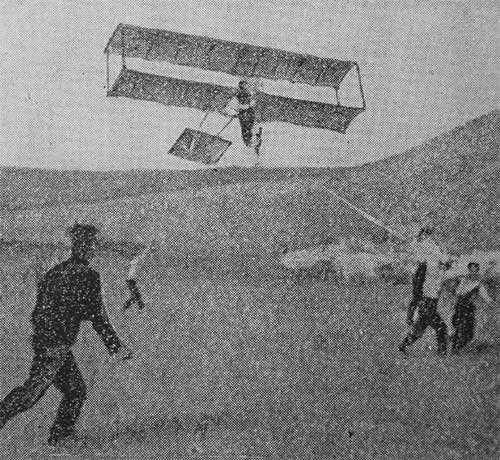
http://www.shinden.org/av_hist/planes/czerw1/01.jpg
Image
Page with text and source of photo: :arrow:
http://www.shinden.org/av_hist/index.ph ... on=0.0.136

MACHINE TRANSLATION WITH ERRORS:
The glider was built in 1911 in Feodozji (the Crimea) the student's math teacher Sergei Czerwinski.

He performed on the flight with the students. Start held by towing the line. Instead of landing gear legs used remote control.
It is believed that the glider was built on the basis of N.Delone brochure published in 1910 in Kiev.
In later years (1925-1927) Czerwinski gliding widely popularized in Poland. In 1927 he built another glider.
Glider Czerwinski was a single biplane of wooden construction. Hull were wykrzyżowane bars. Wooden wings covered with canvas. Tail Box.
Range [m] 6.0
Length [m] 4.0
Height [m] 1.4
Wing Area [sqm] 16
Weight [kg] 20
Total weight [kg] 85
Load. the area. wing [kg / sqm] 5.3

Sources:
Andrew GLASS "Polish aerospace structures 1893-1939", WKiŁ, Warsaw 1977
Join a National Hang Gliding Organization: US Hawks at ushawks.org

View pilots' hang gliding rating at: US Hang Gliding Rating System
JoeF
User avatar
Contributor
Contributor
 
Posts: 4866
Joined: Sat Aug 14, 2010 3:41 pm

Leaping off towers

Postby JoeF » Mon May 13, 2013 2:45 pm

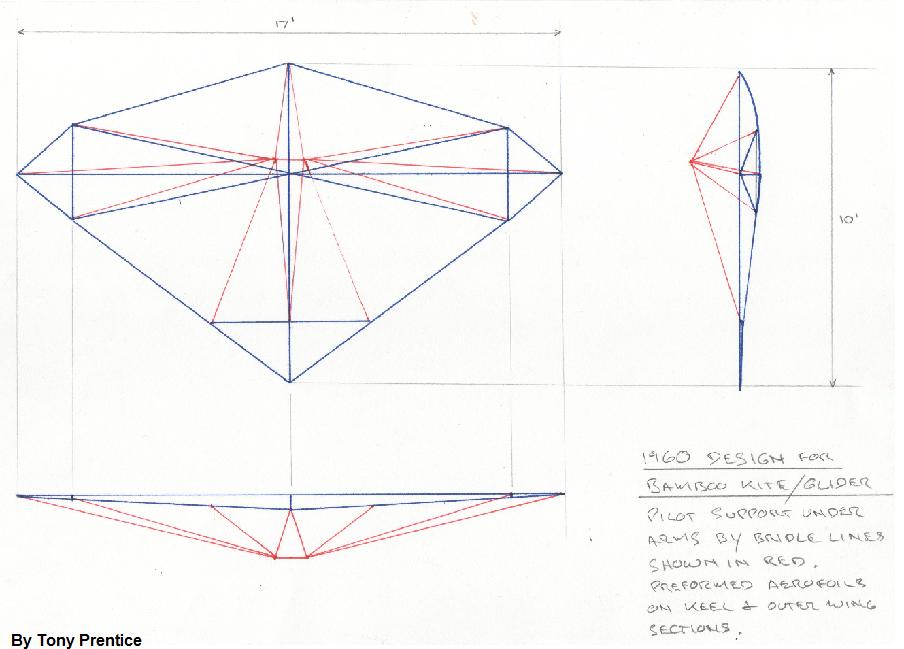
The shown early airframed hang glider was to be a hang glider used as a parachute; it is astronomically probably that some gliding occurs even in the most symmetrical parachutes; hence L/D does not stay at zero. ARP in 1960 had designed an airframed hang glider with tether hang; he was 13 at the time.
Image
There are some high resolution copies on the Internet for "Homo Volans" regarding Fausto Veranzio :) Just control by weight shifting by pulling on left or right tether. :geek:

:arrow: :arrow: Method: Leaping off towers
This method of launching hang gliders ---off towers--- is centuries old. Include a shed as a "tower" if you will. Otto Lilienthal built a hill and a shed and jumped off the shed in order to launch into some hang glider flights. Many boys have done similarly. Some did not live through this launch method. However, with careful planning, watching the wind, having a good glider and some control skills, one may launch a hang glider from some towers. There are some famous and infamous tower launches of hang gliders. One challenge is to clear the tower structure edge.

I am awaiting the time when smart skyscraper owners open rooftop ramps as a hang glider launch site. The hang gliders would be launched when the wind is thought to be appropriate; care for the turbulence around tall buildings would be important. "Seeing" the turbulence in the air to be used could be achieved well now with instruments. Ride the freight elevator in the building and then launch. Fee could be charged for each launch. Fly out for XC. Services at the top before launching: food, shower, massage, exercise equipment, napping facilities, pool, library, etc. Put the roof to good use! Dubai?

Image

Image

Some related notes: http://www.energykitesystems.net/HangGl ... lider.html
Join a National Hang Gliding Organization: US Hawks at ushawks.org

View pilots' hang gliding rating at: US Hang Gliding Rating System
JoeF
User avatar
Contributor
Contributor
 
Posts: 4866
Joined: Sat Aug 14, 2010 3:41 pm

Re: Launching methods

Postby Bill Cummings » Thu Sep 05, 2013 5:37 pm

Launching an inhabited hang glider,
I have accumulated ratings and special skills that relate to launching such as: AT, FL, PL, ST, AWCL, CL, FSL, TUR, issued by the USHPA.
I started out towing because I lived in northern Minnesota where if you ever did find a hill within many miles of home it most often was covered with tall trees.
Northern Minnesota near my home could best be described as either open area lakes or trees.
I started out launching by boat towing. Soon after my friend and I taught ourselves to tow with a snow machine on the frozen lakes.

With what could possibly have been referred to as trespass we taught ourselves to foot launch (FL) from the deserted waste rock man made mine dumps left by the iron ore mining companies. Our closest tow road was one hundred miles from home but there we learned to tow with a car. We moved on to other towing methods to get us launched. Motor cycle, three wheeled ATV, four wheeled ATV. Later I learned to Aero-tow (AT), in its early years, in Florida USA, taught by Campbell Bowen (sp?) and Bobby Bailey.
My friend, Don Ray, and I rigged a platform launch (PL) and taught ourselves to launch from a moving boat. We used a pay-out winch/reel with 3600 feet of rope.

Of all the launching methods that I have done I would have to say that my most preferred method of launching a hang glider is by “Platform Launching.” (PL).
It must be said right here that for a very first flight in a hang glider this PL method is not preferred and should not be attempted unless an instructor is doing the flying. The first time rider is just watching while along for the ride.

Platform launching requires that a person be an accomplished pilot.

Static towing (ST) launching and foot launching (FL) requires a pilot to accelerate to an airspeed above the stall speed of the glider. While still below the stall speed of the glider a pilot is at greater risk of stalling a wingtip that will turn the pilot in an unintended direction. When launching from a GLV Ground Launch Vehicle like a launch dolly at an aero-tow flight park or from a Platform Launch from a boat, truck or trailer, the pilot does not have to commit to a launch until the airspeed is well above stall speed. Stalls on launch and landing are almost always less desirable than stalls at altitude. So the two most troublesome stalls, launch and landing, have that risk cut in half with a platform launch. Of course there is more to launching to consider while choosing between PL or FL. Once launched free flight carries less risk, for the most part, than towed flight. There are exceptions. A crash on a training hill will almost always cause more damage to body and equipment than a low training tow crash over a lake. A low training tow crash over hard ground has a damage coefficient equal to a training hill crash. Quite possibly it could be less since over flat ground a glancing blow may be a greater possibility than being turned downwind into the training hill resulting in an abrupt stop. If the wind was the quantifier let’s only train and launch in no wind conditions. But- it could also be said that launching and landing into a wind is easier and safer. The three dimensional sport of hang gliding isn’t like adding one additional consideration to two dimensions. It is inserting a multiplier of considerations. So which is safer? FL or PL? From the examples above the correct answer is. It depends! It is really an apples and oranges comparison.
There are pilots heard saying, “Tow launching adds a level of complexity to the sport that involves more risk.”
For the pilot that learned by tow launching and is considering taking up foot launching -- the same could also be said.
Logic? Or non-sequitur? (“Tow launching adds a level of complexity to the sport that involves more risk.”)

So my preference as stated earlier is PL over FL. Also that PL reduces the risk of a tip stall during launch. An aero-tow launch dolly and a platform launch helps reduce launch problems as they relate to tip stalls. My preferred launch method is PL over AT. Only because AT involves a threaded bridle in it’s release which has an inherent wrap and capture event possibility while unthreading during release.
Bill C.
Bill Cummings
User avatar
Contributor
Contributor
 
Posts: 3361
Joined: Wed Jul 13, 2011 6:20 pm
Location: Las Cruces NM 88005 (Region 4)

Re: Launching methods

Postby Bill Cummings » Sat Aug 30, 2014 8:30 pm

Maybe someone can help with this PL launching idea.
I happened upon this idea for platform launching over twenty years ago but never gave it the attention it may have deserved.

This idea may work for truck or trailer platform launching and in a small way it seemed to make a difference when I was launching from my boat.

Some of you may have worked this idea out already.

I cut the top of the water ski tow post off in my boat so I could plug in a “T” shaped launching yoke that would hold my hang gliders base tube/control bar.

I drilled a hole all the way through so that the “T” bar yoke could not lift out or spin around.

Our hang gliders nose release rope was attached to the bow eye in the front of the boat. The same place the trailer winch would hook onto when landing the boat. This allowed the nose of the glider to swing left and right.

With much use the holes wallowed and eventually the “T” bar would pivot about two inches to the left or right instead of pointing the same way as the boat.

When I used a vertical stabilizer on the tail of the hang glider I noticed that just before launching and when the boat wasn’t exactly going straight into the wind that the glider would weather vain into the relative wind direction.

I have always thought since then that perhaps a truck or trailer platform tow rig should be rigged up with a pivoting “T” bar for those days that the wind was not straight down the road or runway. The boat had less of a restriction for towing into the wind.

How many degrees left or right of the vehicles orientation the pivoting “T” bar should be limited ---I don’t know!

A cross wind with PL towing isn’t really a big deal but this idea possibly could be a perfect answer. I haven’t heard of it being done yet.
Bill Cummings
User avatar
Contributor
Contributor
 
Posts: 3361
Joined: Wed Jul 13, 2011 6:20 pm
Location: Las Cruces NM 88005 (Region 4)

Re: Launching methods Static Towing

Postby Bill Cummings » Wed Sep 03, 2014 4:28 pm

Static towing.
Precautions in the sport of hang gliding can save a pilot from having a really messed up day.

I learned the hard way that rather than stand around arguing that the noise we just heard was the enemies mortar tube going off, or, no, it was one of ours, that the smarter thing to do would be to get on the ground.

While convalescing at Cam Ranh Bay, South Vietnam I decided that it was past time to get into survival mode up to and even esthetically embracing an obsessive compulsion. (Worry wert) :shifty:

My youngest daughter noticed my condition after the army and bought me a book--
“Warning, caution, danger, everything is bad for you,” by David French.
It was a waste of her money because I already suspected this stuff like sunscreen was bad for me whether I use it or not.

While static towing behind a snow machine on White Water Lake in northern Minnesota (USA) everything that could go wrong whether likely or not had already dashed through my mind. When dealing with Murphy’s Law I always liked to be mentally at least eight chess moves ahead of him.

We would always have clueless people driving their snow machines between our tow snowmobile and the glider when we were just about to commence towing. Hundreds of times we would just wait until they ran over the towline and were gone.

Years went on with this occurring until one year the towline somehow grabbed onto the snow machines belt. It wrapped up about two hundred feet of towline which brought the machine to a belt screeching halt. The guy was madder then my driver and I put together. It took almost a half hour to cut the rope from the guys snow machine.

For hundreds of times before I wasted my time releasing my tow bridle from the towline for a clueless towline crossing and finally, after years, my precautions paid off.
I’ll create a new quote here --feel free to quote me when some statistician starts spouting off.
“Statistics can go straight to hell because statistics don’t feel pain and they don’t bleed.”
EDIT:
A safer thing to do with statistics as they relate to hang gliding would be to multiply the bottom line by a Pain, Blood Multiplier to leave you with a 20/20 hindsight result before the event actually happens and that you would be okay with.

Example: One failed tow line release out of one hundred attempts, times PBM (which is the Pain Blood Multiplier which equals---lets say 80) gives you odds of 80 times out of one hundred. Which would be unacceptable.

So absolutely we need a plan “B.”
Bill Cummings
User avatar
Contributor
Contributor
 
Posts: 3361
Joined: Wed Jul 13, 2011 6:20 pm
Location: Las Cruces NM 88005 (Region 4)

Re: Launching methods

Postby Bill Cummings » Tue Oct 07, 2014 2:09 pm

Launching methods.
Static towing or stationary winch towing, more times than not, will have a pilot launching with a crosswind.

Foot launching from a hill will more times than not be crossing a little.
Instructors for foot launch hang gliding students have written articles that say the pilot detecting a shift in the wind during the take off run should pull the nose of the hang glider down and power straight away from the hill.

With this kind of thinking it should also follow that had there been no wind for the hill launch and in mid run you’re realizing that one wingtip is lower than the other you should do the same thing.

What follows is an improved method of foot launching that isn’t being taught.
The method originated by applying knowledge gained from early water towing concepts that cross over and also work for foot launching.

Pilots that started out water towing while flying seated and using short trick skis as their launching method found out early on that there is a better launching method than lowering the nose and powering straight ahead.

With a wingtip low it actually would make the building forces harder to control as airspeed increased while moving straight ahead. The result would be the low wingtip touching the surface before enough airspeed was developed necessitating the observer in the boat to release the towline.

The only way to keep a low wingtip out of the water while getting up on the water skis is to turn your skis as much as possible in the direction of the low wingtip so that you are moving at an angle to the tow force. This accomplishes two things.
Let’s say the left wingtip was low and about to touch the surface. By steering with the water skis to the left the pilot is applying a force moving the base tube back directly under the wing to level it or be straight below it. Paraglider pilots turn and run sideways under the paraglider all the time when launching. They should have no trouble at all understanding this concept.
The second thing that happens is by angling off to your left is that your left wing is now experiencing more airflow than this maneuver provides for the right wing.
This works to lift the lower left wing.

Beam me up to the hill Scotty. Start the run and see that one wingtip is dropping. What will help is to, “Cut and run.” Angle your run in the direction of your lower wing.
Paraglider pilots already know to say, “WELL NO DUHHHAAA!”

To help reinforce this idea think of this, the hang glider is going left and you run to your right. (CALL 911)

On a tow road static foot launch towing when a wingtip drops cut and run it off at a 45 degree angle toward the low wing.
Bill Cummings
User avatar
Contributor
Contributor
 
Posts: 3361
Joined: Wed Jul 13, 2011 6:20 pm
Location: Las Cruces NM 88005 (Region 4)

Forum Statistics

Who is online

Users browsing this forum: No registered users and 234 guests

Options

Return to Blog Forum