A boy and his dog
 Posted: Sun Nov 11, 2018 8:57 am
Translated from the Dutch
https://www.volkskrant.nl/cultuur-media/zijn-hond-laten-vliegen-en-daar-een-documentaire-over-maken-dat-is-wat-johannes-hogebrink-al-jaren-bezighoudt~bf0dbbbf/
INTERVIEW WITH JOHANNES HOGEBRINK by Maarten van Gestel
July 24, 2018 , 18:21 de Volkskrant
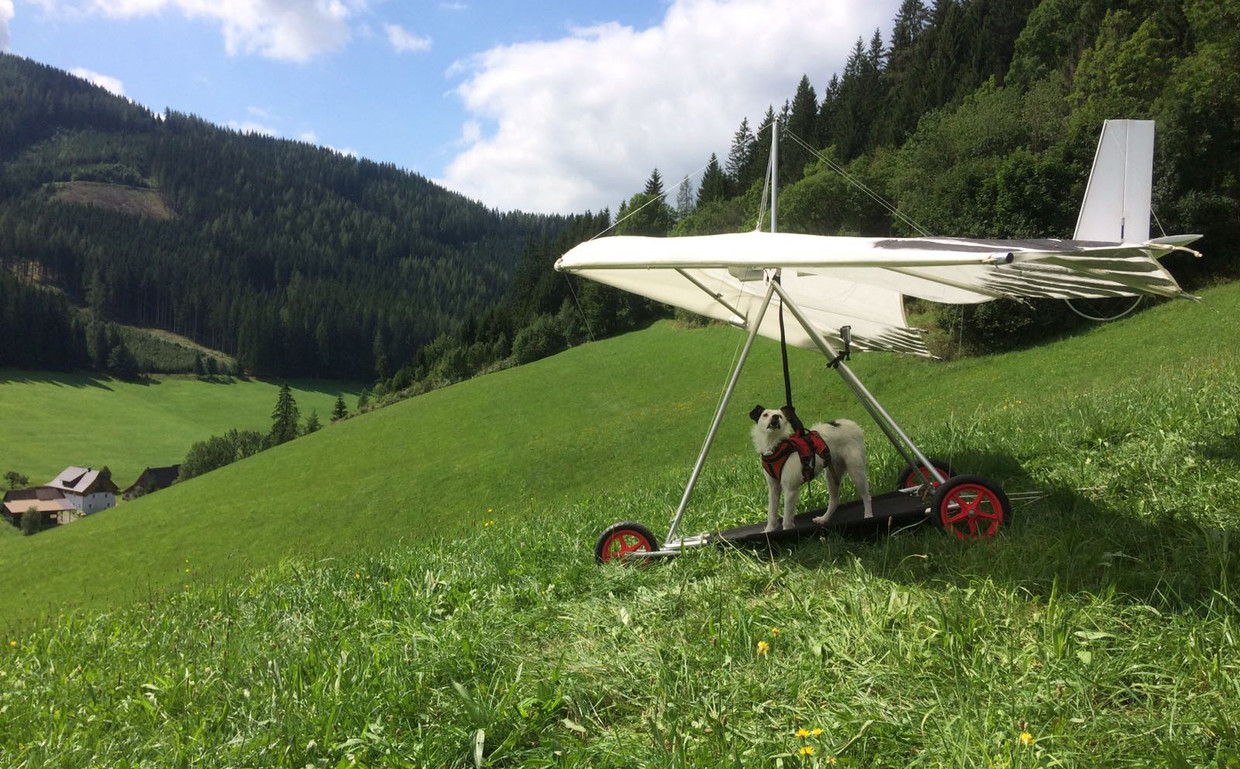
Chayka with the hang glider. (Use Ctl- to view entire photo)
Flying his dog and making a documentary about it, that is what Johannes Hogebrink (41) has been working on since he graduated from the Film Academy seven years ago. Now The Flying Dog is finally finished. The German-language version is likely to appear on Austrian television later this year and the director hopes for screenings on Idfa and in Dutch cinemas, he says in his studio at the Dappermarkt in Amsterdam - scale models of hang gliders with polystyrene dogs hanging above his head. If he had known that it would take so long, he continues, the filmmaker and artist might not have continued the project.
Under one condition, Hoogbrink showed his film to The Volkskrant: that this article does not reveal whether he succeeds in letting his Bosnian street dog Chayka go hang-gliding independently.
Bike tours
The idea arose during the bicycle tours through Amsterdam, which Hoogbrink made with his former dog Sopje on her lap and her paws on the steering wheel.
"On YouTube I had seen dogs skateboarding and surfing," he says. "Hang gliding is much more intuitive. I know from my own experience that this must also be possible for a dog."
In the animation sequence at the beginning of the film, the narrative voice of documentary maker Frans Bromet draws a comparison with the Russian dog Layka, which was shot in the sixties. Layka only went airborne as a passenger, but dog that controls the hang glider by shifting its own body weight - that would be a world first.
For years Hoogbrink sought funds from broadcasters with little success.
"Normally, as a starting director, you first make short films", he says. "Then it is risky to work with me, someone who had produced almost nothing after graduation, to go for a long documentary."
In addition, Dutch broadcasters did not find the idea socially relevant. Only the EO invited him for an interview six years ago. The broadcaster was fascinated by the story but suggested a link with Christianity, because the film was too far removed from the EO. After serious considerations, Hoogbrink abandoned it.
"By a Bible reference in the intro, non-believers would think that The Flying Dog actually was about Jesus, while believers would just go through that artificial link. '
PAULINA
In recent years, Hogebrink had to live by freelance work as a visual designer. It was difficult, because the lack of a stable income does not meet the income requirement for his Russian friend Paulina Siniatkina (28) to come over. The director hopes that De Vliegende Hond will become the driver for a more stable income. "It would be nice if it would bring me new film projects, or if Chayka were allowed to perform in a doggie advertisement, so that Paulina could come to the Nethe'lands."
Obsessive
In the meantime producer René Huybrechtse ( The Dominee, The One Day Life ) of Dutch Mountain Film became intrigued by the 'original vision and personality' of Hoogbrink, who at that time made conceptual drawings for his television film TIM.
"What I liked about his idea was not whether that dog would fly or not, but how obsessive Johannes was," says Huybrechtse. "After five years, I still do not understand why he so desperately wants his dog to fly, but the combination of Johannes' personality and his strange plan resulted in the production of a beautiful film."
After two years, Huybrechtse and Hogebrink succeeded in getting 140,000 euros from the Film Fund, by emphasizing the experimental aspects of the film. The Austrian fund Cinestyria also made money available. In the award, the Film Fund states that Hoogbrink's plan to make a "reverse mockumentary" can contribute to the creative and technical innovation of cinematography. Mockumentary's are fiction, but in the form of a documentary, such as This is Spinal Tap. With The Flying Dog, Hoogbrink tries to turn that genre around by "making a documentary for a change that feels unbelievable - because the film is about following incredible dreams". In the film, the viewer is occasionally misled. This is how Chayka crashes halfway through the film. The question is: has that crash really occurred?
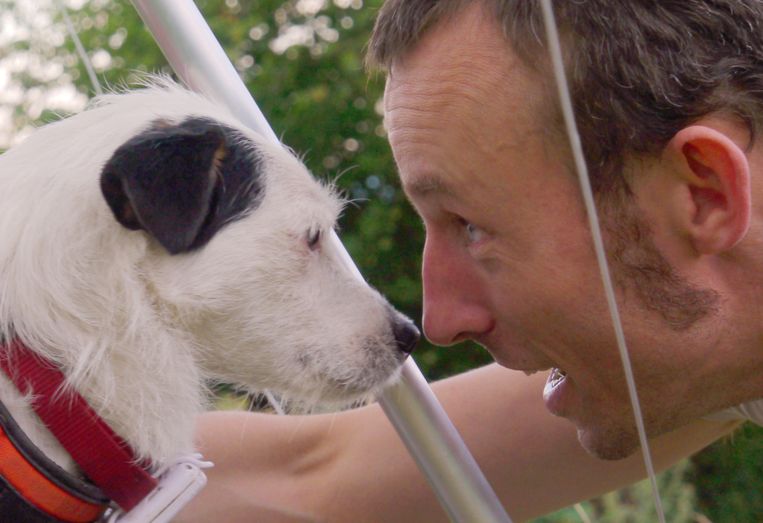
Chayka and Johannes Hogebrink with the shooting of De Vliegende Hond. Picture by Stefan van de Staak
Practice cable car
Hogebrink was also delayed by the death of his previous dog Sopje, he says. "If your relationship ends, you do not immediately look for a new friend."
His new dog, Chayka, turned out not to be so brave - the filmmaker suspected previous trauma and mounted flashbacks to Chayka's street dog life in Bosnia in his film - so the filmmaker spent a year preparing the animal for a practice cable car. The production of the device also caused problems: Hoogbrink paid for a pocket scale model from Germany, which did not contribute anything. Eventually an American builder made the hang glider used in the film. Hogebrink says he continued because his three big loves come together in this project: flying, filmmaking and dogs.
"Can you do this to a dog? was the question that producer Huybrechtse often asked himself in the beginning. An accident and perhaps even the death of the creature could mean a public relations disaster for the production company. Still, he had enough confidence in Hoogbrink to continue.
"John and that dog were one if you saw them together. I never feared that he would treat his dog badly."
Hogebrink is not afraid of angry animal rights activists.
"Of course there was danger, that makes it an exciting adventure to watch. But I had never sent Chayka down the hill if he was not 100% ready for it himself. "
In addition, the flying exercises were less dangerous than they sound: the beast had to control down the hang-glider of a sloping hill, be lifted up by the air and would only have to fly a few meters above the ground. According to the filmmaker, a crash had been comparable to a fall of your bike in the grass. In addition, Hoogbrink emphasizes that his dog has become more self-assured through intensive years of training.
"He is now happily swishing on other dogs and is riding more enthusiastically on the bike than my previous dog. For Chayka, it's a rags to riches story "
https://www.volkskrant.nl/cultuur-media/zijn-hond-laten-vliegen-en-daar-een-documentaire-over-maken-dat-is-wat-johannes-hogebrink-al-jaren-bezighoudt~bf0dbbbf/
INTERVIEW WITH JOHANNES HOGEBRINK by Maarten van Gestel
July 24, 2018 , 18:21 de Volkskrant
Chayka with the hang glider. (Use Ctl- to view entire photo)
Flying his dog and making a documentary about it, that is what Johannes Hogebrink (41) has been working on since he graduated from the Film Academy seven years ago. Now The Flying Dog is finally finished. The German-language version is likely to appear on Austrian television later this year and the director hopes for screenings on Idfa and in Dutch cinemas, he says in his studio at the Dappermarkt in Amsterdam - scale models of hang gliders with polystyrene dogs hanging above his head. If he had known that it would take so long, he continues, the filmmaker and artist might not have continued the project.
Under one condition, Hoogbrink showed his film to The Volkskrant: that this article does not reveal whether he succeeds in letting his Bosnian street dog Chayka go hang-gliding independently.
Bike tours
The idea arose during the bicycle tours through Amsterdam, which Hoogbrink made with his former dog Sopje on her lap and her paws on the steering wheel.
"On YouTube I had seen dogs skateboarding and surfing," he says. "Hang gliding is much more intuitive. I know from my own experience that this must also be possible for a dog."
In the animation sequence at the beginning of the film, the narrative voice of documentary maker Frans Bromet draws a comparison with the Russian dog Layka, which was shot in the sixties. Layka only went airborne as a passenger, but dog that controls the hang glider by shifting its own body weight - that would be a world first.
For years Hoogbrink sought funds from broadcasters with little success.
"Normally, as a starting director, you first make short films", he says. "Then it is risky to work with me, someone who had produced almost nothing after graduation, to go for a long documentary."
In addition, Dutch broadcasters did not find the idea socially relevant. Only the EO invited him for an interview six years ago. The broadcaster was fascinated by the story but suggested a link with Christianity, because the film was too far removed from the EO. After serious considerations, Hoogbrink abandoned it.
"By a Bible reference in the intro, non-believers would think that The Flying Dog actually was about Jesus, while believers would just go through that artificial link. '
PAULINA
In recent years, Hogebrink had to live by freelance work as a visual designer. It was difficult, because the lack of a stable income does not meet the income requirement for his Russian friend Paulina Siniatkina (28) to come over. The director hopes that De Vliegende Hond will become the driver for a more stable income. "It would be nice if it would bring me new film projects, or if Chayka were allowed to perform in a doggie advertisement, so that Paulina could come to the Nethe'lands."
Obsessive
In the meantime producer René Huybrechtse ( The Dominee, The One Day Life ) of Dutch Mountain Film became intrigued by the 'original vision and personality' of Hoogbrink, who at that time made conceptual drawings for his television film TIM.
"What I liked about his idea was not whether that dog would fly or not, but how obsessive Johannes was," says Huybrechtse. "After five years, I still do not understand why he so desperately wants his dog to fly, but the combination of Johannes' personality and his strange plan resulted in the production of a beautiful film."
After two years, Huybrechtse and Hogebrink succeeded in getting 140,000 euros from the Film Fund, by emphasizing the experimental aspects of the film. The Austrian fund Cinestyria also made money available. In the award, the Film Fund states that Hoogbrink's plan to make a "reverse mockumentary" can contribute to the creative and technical innovation of cinematography. Mockumentary's are fiction, but in the form of a documentary, such as This is Spinal Tap. With The Flying Dog, Hoogbrink tries to turn that genre around by "making a documentary for a change that feels unbelievable - because the film is about following incredible dreams". In the film, the viewer is occasionally misled. This is how Chayka crashes halfway through the film. The question is: has that crash really occurred?
Chayka and Johannes Hogebrink with the shooting of De Vliegende Hond. Picture by Stefan van de Staak
Practice cable car
Hogebrink was also delayed by the death of his previous dog Sopje, he says. "If your relationship ends, you do not immediately look for a new friend."
His new dog, Chayka, turned out not to be so brave - the filmmaker suspected previous trauma and mounted flashbacks to Chayka's street dog life in Bosnia in his film - so the filmmaker spent a year preparing the animal for a practice cable car. The production of the device also caused problems: Hoogbrink paid for a pocket scale model from Germany, which did not contribute anything. Eventually an American builder made the hang glider used in the film. Hogebrink says he continued because his three big loves come together in this project: flying, filmmaking and dogs.
"Can you do this to a dog? was the question that producer Huybrechtse often asked himself in the beginning. An accident and perhaps even the death of the creature could mean a public relations disaster for the production company. Still, he had enough confidence in Hoogbrink to continue.
"John and that dog were one if you saw them together. I never feared that he would treat his dog badly."
Hogebrink is not afraid of angry animal rights activists.
"Of course there was danger, that makes it an exciting adventure to watch. But I had never sent Chayka down the hill if he was not 100% ready for it himself. "
In addition, the flying exercises were less dangerous than they sound: the beast had to control down the hang-glider of a sloping hill, be lifted up by the air and would only have to fly a few meters above the ground. According to the filmmaker, a crash had been comparable to a fall of your bike in the grass. In addition, Hoogbrink emphasizes that his dog has become more self-assured through intensive years of training.
"He is now happily swishing on other dogs and is riding more enthusiastically on the bike than my previous dog. For Chayka, it's a rags to riches story "


