Sign in, say "hi", ... and be welcomed.

Re: The 5 ft-packed-HG Movement

Postby KaiMartin » Mon Aug 31, 2015 6:37 pm

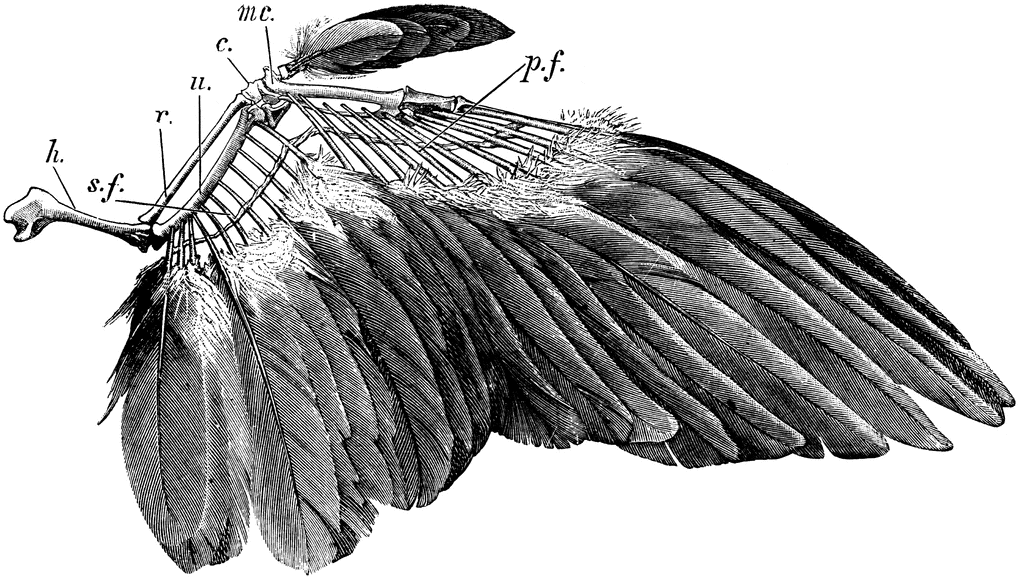
Some more thoughts on the way birds package their wings:

1) On fold, the feathers automatically assume a space efficient orientation. No active motion by the bird involved in addition to the actual fold.

2) Unlike a sail, feathers do not build span wise tension. So the joints do not need to be locked in position.

3) Can anybody build a real Jurassic Park? I'd immediately buy a ticket just to see how Pterosaurs dealt with this kind of problem.

---<)kaimartin(>---
KaiMartin
User avatar
Contributor
Contributor
 
Posts: 146
Joined: Tue Apr 21, 2015 11:43 am

Re: The 5 ft-packed-HG Movement

Postby brianscharp » Mon Aug 31, 2015 10:29 pm

Unlike a sail, feathers do not build span wise tension.

But the skin they are attached to does.
brianscharp
User avatar
Contributor
Contributor
 
Posts: 304
Joined: Tue Nov 11, 2014 12:49 pm

Re: The 5 ft-packed-HG Movement

Postby KaiMartin » Tue Sep 01, 2015 10:40 am

brianscharp wrote:
Unlike a sail, feathers do not build span wise tension.

But the skin they are attached to does.

I am not convinced. Without an efficient locking mechanism in place tension would have to be matched by muscles. I not aware of such muscles in the wing. It would be strenuous and energy inefficient for the bird, too. Soaring birds constantly move their hand(?) with the primaries with respect to the secondary feathers which are attached to the ulna. This would not be possible if the wings skin would have to be tensioned like the sail of a hang glider.

IMHO, the force on each feather converts into an upward torque at its base, which is directly countered by the skin and connective tissue.

---<)kaimartin(>---
KaiMartin
User avatar
Contributor
Contributor
 
Posts: 146
Joined: Tue Apr 21, 2015 11:43 am

Re: The 5 ft-packed-HG Movement

Postby brianscharp » Tue Sep 01, 2015 12:29 pm

KaiMartin wrote:
brianscharp wrote:
Unlike a sail, feathers do not build span wise tension.

But the skin they are attached to does.

I am not convinced. Without an efficient locking mechanism in place tension would have to be matched by muscles. I not aware of such muscles in the wing. It would be strenuous and energy inefficient for the bird, too. Soaring birds constantly move their hand(?) with the primaries with respect to the secondary feathers which are attached to the ulna. This would not be possible if the wings skin would have to be tensioned like the sail of a hang glider.

IMHO, the force on each feather converts into an upward torque at its base, which is directly countered by the skin and connective tissue.

---<)kaimartin(>---

It's hard for me to imagine skin not becoming looser when folded back upon itself and more taught when fully extended.
http://etc.usf.edu/clipart/48100/48112/ ... e_wing.htm
Image
http://etc.usf.edu/clipart/59100/59193/ ... ing_md.gif
http://etc.usf.edu/clipart/48100/48106/ ... ier_md.gif
brianscharp
User avatar
Contributor
Contributor
 
Posts: 304
Joined: Tue Nov 11, 2014 12:49 pm

Re: The 5 ft-packed-HG Movement

Postby JoeF » Thu Sep 03, 2015 8:02 am

Air bones
One type:
SandwichedWebHybridAirBeam.png
SandwichedWebHybridAirBeam.png (20.41 KiB) Viewed 10690 times


tags: air beam, airbeam, webbed air beam, webbed airbeam
Join a National Hang Gliding Organization: US Hawks at ushawks.org

View pilots' hang gliding rating at: US Hang Gliding Rating System
JoeF
User avatar
Contributor
Contributor
 
Posts: 4867
Joined: Sat Aug 14, 2010 3:41 pm

Re: The 5 ft-packed-HG Movement

Postby KaiMartin » Sun Sep 06, 2015 7:36 am

brianscharp wrote:It's hard for me to imagine skin not becoming looser when folded back upon itself and more taught when fully extended.

Skin is not a good material to hold tension for extended periods of time. It yields and stretches in the long run. Tissues to which can withstand ongoing tension are tendons and ligaments.

I learn by the day: The cord that connects the feathers in the image you linked to is actually a ligament. It is connected to the muscle "expansor secundarium" which is attached to the humerus. This is a smooth muscle. It can stay tensioned for an extended period of time without the need of constant energy input. So it is well equipped to hold the feathers down.

However, I still think that feather-like components offer a chance to transfer lifting force from the surface to a spar without tension. If the spar is placed at the chord-wise centre of lift torque is insignificant, too. This would allow the spar to bend without severe deterioration of the airfoil. It would allow for joints or even an inflatable spar.

Just how viable is the notion of "feather-like components". Bird feathers are certainly way beyond the scope of any man made hang glider construction when it comes to stability vs weight. But maybe we don't have to go all the way. After all, hang glider sail cloth is not record breaking light weight -- about 170 g/m² to 200 g/m². This is something to work with.

A properly scaled primary feather of an eagle would be about 1.5 m long and 30 cm wide. It would be loaded by about 2 kg in smooth, straight flight and about 10 kg in tight spirals before the pilot passes out. Maybe, Styrofoam sandwiched between thin Mylar foils can do the trick. A quick trip to the local home improvement store got me 5 mm Styrofoam meant for thermal insulation, a sheet of metallized Mylar film in the form of an astro blanket and some styro compatible glue. Will report my mileage....

---<)kaimartin(>---
KaiMartin
User avatar
Contributor
Contributor
 
Posts: 146
Joined: Tue Apr 21, 2015 11:43 am

Re: The 5 ft-packed-HG Movement

Postby KaiMartin » Sun Sep 06, 2015 7:55 am

Hi Joe.
JoeF wrote:Air bones

What is the black line in the middle supposed to stand for?
I guess, it must be something more rigid than a piece of cloth. It still should fit within the 5ft package requirement.
→ A sheet made of connected parallel rods -- much like a sushi mat (makisu)?
→ A series of flat rigid sheets with joints in between?
→ A sheet thin enough to be repeatedly rolled to an acceptable diameter (e.g. 0.5 m)
→ Something else, I did not have the wit to imagine?

---<)kaimartin(>---
KaiMartin
User avatar
Contributor
Contributor
 
Posts: 146
Joined: Tue Apr 21, 2015 11:43 am

Re: The 5 ft-packed-HG Movement

Postby JoeF » Sun Sep 06, 2015 8:22 am

WebThreeViews.png
WebThreeViews.png (1.42 KiB) Viewed 10660 times

Thanks, Kai,
Yes, the black line in the cross section view is a web element. The web element choices vary. Some explorers have used cloth of various makes. The web may or may not be connected to the encasement. There are pros and cons to connecting the web to the case or not connecting the web element (keeping it a loose part). The literature has the textile webs that are connected to the encasement. But also the web element may be a sheet or plate of other materials: Mylar, Kevlar, carbon-composite, plywood, complex foam I-beam structures, etc. The web element may be loose and NOT connected to the exterior case; my intentions are first going to use loose sturdy coilable (wearable during transport is a choice) web. My suggestion goes towards two directions: 1. Coilable veneer of carbon-fiber epoxy 2. Flexible-hinged flat segments 5-ft long that zig-zag fold at the flexible hinge (hinge bonded to each flat plate; these web plates, as indicated on the drawing note may be "tapered" in several ways as wanted: thickening in plate thickness, width change from top to bottom of the plate or firm sheet, or varied lightening holes, or I add now variation of embedded CF population. Thus a hybrid inflated air bone could be tapered in various ways. The casing and the bladders may be tapered to match the taper of the web element. Notice too that the web may be a collection of less-firm thin plates; e.g., have two thinner coilable plates that coil to a smaller diameter because of their thinness; then upon use, the two thinner web-used plates pile next to each other and have an aggregate firmness when squeezed by the two bladders when encased in the porous (acceptable) outside casing. The similar strategy for the web could be with three coilable thinner plates; or four or five. If the aggregated coilable sheets were textured in a way that one face of one web element married the face of the next piled web element, then there would be some additional shear grab of the adjacent web elements; consider also a slight magnetic arrangement where the surfaces of web elements were magnetic to each other; then upon piling the two or more coilable web element, there would be the "bonding" forces of the magnetic faces to help aggregate the thin web elements to a more sturdy spar web for centering in the air bone. One might consider a gentle Velcro facing for such web elements to pile for the gross web for the air bone. The web complex (one or more parts; one thickness or pile of two or more) may be loose and not connected to the case and not connected to the two air bladders.

For example: the web element (black line in cross section view) might have a size when used as: 30 cm x 0.0794 cm x 9 m [[or with some taper regarding the 30 cm, etc]].

Also, Kai, the option of non-hinged and non-coilable flat web element segments is available where then one might bolt the 5-ft web segments together to form longer parts of the web.

Notice the option on the web element: The width of the web (top to bottom) may be sized to be the same as the diameter of the case diameter or less or greater than the case diameter. I have not analyzed the pros and cons of having a firm web greater than the diameter of the outside case or less than or same as diameter of the case. Notice that a skin-grab of the case by the web might be easily obtained if small projections occurred on the edges of the web element; those small projections might puncture through the outside case and form a helpful bonding mechanically without glues or other means; the pros and cons of such arrangement have not been explored by me yet. Recall that the casing, that is, the outside gross casement need not be air tight; indeed it could be quite porous to air; but the shelling effect of the casing is part of the good deal of all of this; when the case is tensed by the inflation of the two bladders, then a shell-effect occurs for giving the structural macro spar. The final macro or gross spar is the foundation for wing ribs, mounting high hat, and mounting control and Safe-Splat members.

Again, the above notes focus on the web-centered air beam that is not using the splint-and-cable structure. HOWEVER, one may explore combining both the splint-and-cable tensairity method WITH the web-squeezed method. I have not yet constructed a hybrid combination spar that uses both strategies at once.
Best,
Joe F.
Join a National Hang Gliding Organization: US Hawks at ushawks.org

View pilots' hang gliding rating at: US Hang Gliding Rating System
JoeF
User avatar
Contributor
Contributor
 
Posts: 4867
Joined: Sat Aug 14, 2010 3:41 pm

Re: The 5 ft-packed-HG Movement

Postby Frank Colver » Tue Sep 22, 2015 6:58 am

Today, Sept 22, I'll be visiting Sheri Tingey at Alpacka Raft in Mancos CO. If, in conversation, the opportunity arises to bring up the subject of inflatable HG components I'll do that.

Their factory could make some very high quality custom inflatable HG parts if they wanted to take on the task (they are quite busy building packrafts).

Frank C.
Frank Colver
User avatar
Contributor
Contributor
 
Posts: 1292
Joined: Tue May 24, 2011 11:21 am

Re: The 5 ft-packed-HG Movement

Postby ARP » Fri Oct 09, 2015 4:56 am

http://bicsports.co.uk/acatalog/Bic_11_ ... board.html

This board is using the drop fibre idea from the Goodyear inflatable aircraft.
ARP
User avatar
Contributor
Contributor
 
Posts: 280
Joined: Thu Jun 14, 2012 1:46 am

PreviousNext
Forum Statistics

Who is online

Users browsing this forum: Majestic-12 [Bot] and 784 guests

Options

Return to Hang Gliding General