Personal Journals about Hang Gliding

The problem with ultralights

Postby Rick Masters » Wed Feb 10, 2016 11:14 am

Image
Rick Masters
Contributor
Contributor
 
Posts: 3260
Joined: Fri Jul 15, 2011 5:11 am

Re: The problem with ultralights

Postby wingspan33 » Wed Feb 10, 2016 9:39 pm

Aren't hang gliders ultralights? None of mine have ever burst into flames like that. :shock:

Perhaps that's one of those powered ultralights? They typically add a motor and gasoline, which just might result in a picture like that. Ding Dang, . . . I wonder, can they get insurance?
wingspan33
User avatar
Contributor
Contributor
 
Posts: 1152
Joined: Fri Aug 13, 2010 8:24 pm

Re: The problem with ultralights

Postby Rick Masters » Wed Feb 10, 2016 10:17 pm

Our plans provide EAA members in the U.S. with extensive liability and aircraft hull insurance for all types of aircraft.

EAA Insurance Solutions has aircraft insurance plans available to all types of aircraft including: standard, experimental (including one-of-a-kind), vintage, aerobatic (including contests and airshows), warbirds, seaplanes and amphibians, helicopters and gyrocopters, powered parachutes, weight shift control (trikes), and gliders and sailplanes.

As an added bonus, most EAA members are eligible to receive a special "EAA Endorsement" that offers the following additional insurance coverage at no extra charge:

Zero deductible from day one
First flight coverage for homebuilt aircraft
$5,000 for personal effects of passengers
$10,000 medical payments
$25,000 search and rescue
$25,000 aircraft recovery for emergency/precautionary off-airport landings
$50,000 liability insurance for aircraft hangars and hangar content
Non-owned coverage
After-the-sale liability insurance for both production and experimental aircraft
Coverage available for aircraft powered by approved auto engine conversions
Expanded insurance for hangar area where you base your aircraft
No family sublimits on liability insurance coverage
No "per person" sublimit on liability insurance
Powered Parachute & WSC Trike Insurance Plan
EAA has pioneered the first insurance plan exclusively for EAA members that includes liability insurance for bodily injury to passengers, providing, in addition to personal uses, insurance options for flight instruction, discovery flights, and sales demonstration flights, all underwritten by a licensed U.S. Aviation Insurance Company.
From student pilot to commercial pilot, the EAA Powered Parachute and WSC Trike Insurance Plan is really a one-of-a-kind EAA member benefit.
If you have questions, contact one of the aviation insurance professionals with EAA Insurance Solutions administered by Falcon Insurance Agency at 1-866-647-4322.
VIDEO:   http://www.eaavideo.org/video.aspx?v=3292519466001
and        http://www.eaavideo.org/video.aspx?v=4662610833001
Rick Masters
Contributor
Contributor
 
Posts: 3260
Joined: Fri Jul 15, 2011 5:11 am

Re: The problem with ultralights

Postby Rick Masters » Thu Feb 11, 2016 9:10 pm

Wow.
I don't know if anybody else went through the videos, but after viewing them, I think I understand why USHPA lost its insurance.
You can't mix airframes with parachutes. It was a big mistake to try.
When USHPA exceeded 50% parachutes a few years ago, the underwriters freaked out.
It's too weird for them. That's all.
Any other opinions?

And I now suspect it may not even be difficult to get really cheap 3PL insurance for a pure hang gliding club.
Hang gliders are just cheapo sailplanes.
Every member has their own aircraft. No sharing. Stored indoors.
Insurance is waived for everything except 3PL liability. No damage coverage for gliders. No medical coverage.
The club keeps ratings, flight time and records current, and inspects all gliders periodically.
No paragliders. No tandem. No towing. Strict adherence to FAR 103 (violation voids claim).
That's it.

Seriously, check it out.
Rick Masters
Contributor
Contributor
 
Posts: 3260
Joined: Fri Jul 15, 2011 5:11 am

Re: The problem with ultralights

Postby Harry » Fri Feb 12, 2016 9:48 am

Powered parachutes. This design seems to fly much faster which may be clear of the dead man's curve.

http://www.eaavideo.org/video.aspx?v=53226345001
Harry Martin
Fear is not boring, the stupid shall be punished
Harry
User avatar
Contributor
Contributor
 
Posts: 68
Joined: Sun Jul 19, 2015 7:17 am
Location: Wild and windy Casper, Wyoming

Re: The problem with ultralights

Postby Rick Masters » Fri Feb 12, 2016 12:54 pm

Powered parachutes. This design seems to fly much faster which may be clear of the dead man's curve.

    Paragliders are highly-modified parachutes designed for soaring. Rectangular parachutes are designed for stability and reliable freefall deployment. If you compare a paraglider to a rectangular parachute, you will appreciate how critically balanced the paraglider is. By that, I mean because the chord is shorter, the cg point is more critical because the range of movement away from the cg that affects pitch is narrower. The high aspect, ribbon-like design of the paraglider, the critical cg, the dangerous airfoil-distorting control system and the light loading combine to make the paraglider much more susceptible to collapse than rectangular parachutes.
    A parachute has much more drag and a steeper glide path than a paraglider. When you hang a power unit on a parachute, you can force it to fly faster than a paraglider because it has less tendency to lose its shape or controllability. Because of the higher drag, a powered parachute requires a higher horsepower engine than a powered paraglider. Some can get up to 35 mph while a paraglider is limited to around 25. At these higher speeds, the ram-air design of the parachute achieves a near semi-rigid configuration with high kinetic energy - which results in a much safer platform than a powered paraglider.
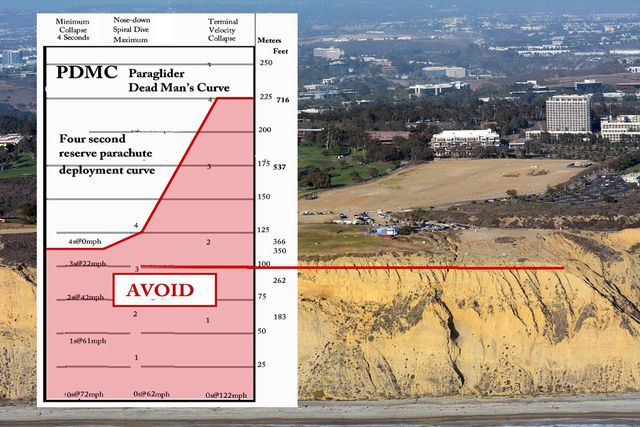
    High kinetic energy and a rigid airfoil, such as that of hang gliders or microlights, makes one immune to the effects of a dead man's curve because
1) the wing, possessing an airframe, cannot collapse,
2) higher speed causes the emergency reserve parachute to open faster, lowering the effective reserve deployment altitude, and
3) kinetic energy provides a reserve of controlability.
    While these features are severely lacking in paragliders and, to a lesser extent, in powered paragliders, the powered parachute comes closer to meeting them.
    When I announced the Paraglider Dead Mans Curve in June of 2009 http://www.paraglidingforum.com/viewtopic.php?t=25711, I did not include parachutes or power units. I was in fact focused on the result of paraglider canopy collapse at or below effective parachute deployment altitude, which is similar to the helicopter dead man's curve. Again, this is not a concern when flying robust airfoils with high kinetic energy. And while this concept seems forever beyond the reach of most soaring parachutists, you, Harry, have grasped it immediately.
    I wonder why that is?

Image
Rick Masters
Contributor
Contributor
 
Posts: 3260
Joined: Fri Jul 15, 2011 5:11 am

Re: The problem with ultralights

Postby Frank Colver » Sun Feb 14, 2016 11:20 pm

Interesting.

I was explaining the PGDMC the other day to a former helicopter pilot after he mentioned the HDMC. He then understood the collapse in turbulence problem with PG and asked: "what about the skydiving gliding rectangular chute". I said that wasn't nearly as much of a problem because it was much lower aspect ratio which makes it less prone to collapse and was flying at a higher speed and area loading which made it stiffer and better able to fly through turbulence without collapse. Also quicker recovery if disturbed. He then understood the difference immediately.

Certainly not difficult for him to quickly understand the safety difference between the two types of gliding parachutes - high aspect ratio, light loading vs low aspect ratio, high loading.

Frank C.

BTW - He was also the former airline pilot who told me about the pilots shoveling down the sand dunes off the end of LAX (see topic on FDGS page).
Frank Colver
User avatar
Contributor
Contributor
 
Posts: 1292
Joined: Tue May 24, 2011 11:21 am

Re: The problem with ultralights

Postby Rick Masters » Mon Feb 15, 2016 1:23 pm

Rick Masters
Contributor
Contributor
 
Posts: 3260
Joined: Fri Jul 15, 2011 5:11 am

Re: The problem with ultralights

Postby Rick Masters » Tue Mar 01, 2016 10:43 am

Image

...during the flight, he said he felt heat coming from behind him. When he turned around, Caywood noticed the paraglider's motor was on fire.
Up roughly 1,200 feet in the air, Caywood said he shut the motor off and began removing his straps while he was spiraling down toward the ground.
http://www.gainesville.com/article/20150703/ARTICLES/150709897
Rick Masters
Contributor
Contributor
 
Posts: 3260
Joined: Fri Jul 15, 2011 5:11 am

Re: The problem with ultralights

Postby Rick Masters » Thu Mar 24, 2016 5:11 pm


Can you count the judgement errors?
Rick Masters
Contributor
Contributor
 
Posts: 3260
Joined: Fri Jul 15, 2011 5:11 am

Forum Statistics

Who is online

Users browsing this forum: No registered users and 261 guests

Options

Return to Blog Forum