Wednesday, February 15, 2017
Getting ready to pour concrete on rocks stacked at the edge emergency spillway

Where's the rebar?
YOU KNOW WHAT THEY'RE DOING IN THEIR PANIC?
JUST PUMPING CONCRETE OVER THE BOULDERS.
IT WON'T WORK!
CONCRETE CURING
Curing concrete will make your concrete stronger and better, but only if you do it right-timing is key
By Bill Palmer, Concrete Network Columnist
When concrete is born-when you place fresh concrete where you want it to live out its life-it's like a baby: very sensitive and easily ruined. If you take good care of it, when it's young it will grow up to be a strong and reliable adult; neglect it, and you'll be sorry! Curing is all of the things that we do to keep our concrete baby happy during the first week or so of its life: maintain the proper temperature (neither too hot nor too cold) and dampness (I know, most babies prefer to be dry-concrete likes being difficult). Curing is easy to skip in the instant but that will have a major impact on the quality of your finished work. While curing is important for all concrete, the problems that arise from not curing are most obvious with horizontal surfaces. An uncured slab, whether decorative or plain gray, is likely to develop a pattern of fine cracks (called crazing) and once it's in use the surface will have low strength that can result in a dusting surface that has little resistance to abrasion.
-----------------
ALLOW PROPER TIME TO WATER CURE
After concrete is placed, the concrete increases in strength very quickly for a period of 3-7 days. Concrete which is moist cured for 7 days is about 50% stronger than uncured concrete.
-----------------
Now we know why they finished the dam a year ahead of time.
It's time to start packing up your stuff if you live in Sacramento.-----------------
Oroville Emergency Spillway: Does this Look Like Bedrock to You?February 13th, 2017 by Roy W. Spencer, Ph. D.
http://www.drroyspencer.com/2017/02/oroville-emergency-spillway-does-this-look-like-bedrock-to-you/I’ve had a little criticism here and on Facebook that I’m not a geologist, so I shouldn’t be second-guessing the Oroville Dam engineers. They called for evacuations last evening out of an abundance of caution. That the emergency spillway is no doubt built on bedrock, and so it is safe.
Well, if it was only out of an abundance of caution that evacuations were ordered, why did emergency officials claim that there might be only one hour until the concrete weir topping the emergency spillway would fail? Hmmm?
And take a look at one of the ravines that eroded from only a little over 24 hours of flow over the emergency spillway
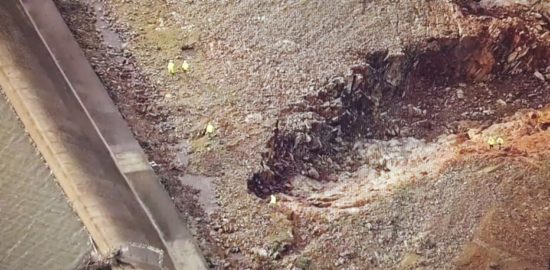
One of two major eroded areas just below the emergency spillway of Oroville Dam (Feb. 13, 2017). The little yellow spots are people.
Does that erosion feature look like it’s cutting into bedrock? Even though the spillway is supposed to handle 250-350,000 CFS, it was only ~10,000 CFS total flow across the 1,700 ft. long weir that caused this.
An Army Corp of Engineers engineer named Joe Countryman said in a Sacramento Bee interview that, essentially, if the emergency spillway was overtopped again, it would fail and that the hydraulic hammering action of the water could possibly eat away the fractured greenschist and "drain the reservoir."  http://www.sacbee.com/news/state/california/water-and-drought/article132356269.html
The latest press conference held shortly after noon today suggested that officials are avoiding hard questions. At one point a reporter asked, “With two parts of the system compromised (the main spillway and emergency spillway), how secure can people be?“. The speaker was not allowed to answer the question.
I honestly don’t know what’s going on, but if I lived in the flood plain (and now one of the near-200,000 people evacuated), I’d be wanting some more definitive information.
 Home
Home

 by Rick Masters » Wed Feb 10, 2016 11:21 pm