Four-Nest Pack for UPHGA non-standard but feasible approach is to create one nest that holds **two queenposts (QPs) and one kingpost (KP)**. At first glance, one might want the two QPs to match exactly in OD and ID, but for packing purposes it can be reasonable to tolerate asymmetry. The two QPs could differ slightly in size while still maintaining adequate strength if dimensions are chosen carefully. In this arrangement, the KP would be the smallest OD item in the nest, giving a **QP–QP–KP configuration**.
In some UPHG packings, there could be
four distinct nests of frame segments:
1. Left wing nest (perhaps 1, 2, 3, 4, or 5 segments)
2. Right wing nest (perhaps 1, 2, 3, 4, or 5 segments)
3. Keel nest (perhaps 1, 2, 3, 4, or 5 segments)
4. Post nest (containing QP, QP, KP) (perhaps 1, 2, 3, 4, or 5 segments)
Depending on the arrangement of the four nests, the
frame pack cross-section could take one of three forms:
1.
Linear (1 × 4) – all tubes in a single row.
2.
Square (2 × 2) – two rows of two tubes, forming a square cross-section.
3.
Slanted rhombic – staggered or diamond layout, similar to a small triangular lattice.
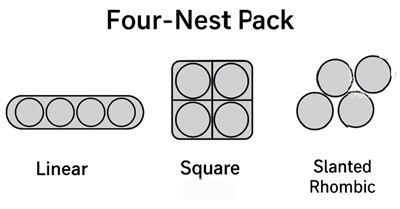
- FourPackedNestsOptions.jpg (20.46 KiB) Viewed 133231 times
Triangle Control Frame (TCF) and Base Considerations:The TCF consists of two downtubes (the QPs) and a tube or bar often called the
control bar or
basebar, forming the base of the triangle. When using wire rigging, one or more crosslines may substitute for the rigid basebar while still providing a firm base under positive flight loads. These base cables allow the pilot to control pitch via weight shifting. Pre-tension in the rigging—whether neutral or under negative flight loads—maintains tension in the base cable. Choosing rigging lines to substitute for a rigid basebar is an option some designers may adopt (and is planned in my designs).
This approach allows
compact packing, tolerates asymmetrical queenposts, and offers flexibility in frame design by optionally substituting a rigid basebar with rigged cables.
---
P.S. In recreational hang gliding, the cable-stayed triangle control frame was used in sport hang gliding meets in the
first decade of 1900s by more than W. Simon.

So, one might refrain from attributing invention of such to
later users of the simple rigged control device.

Fall Filler:
https://youtube.com/shorts/Yogl-hbMr8k?si=5wwfpxOvFi-IObj6
 Home
Home


